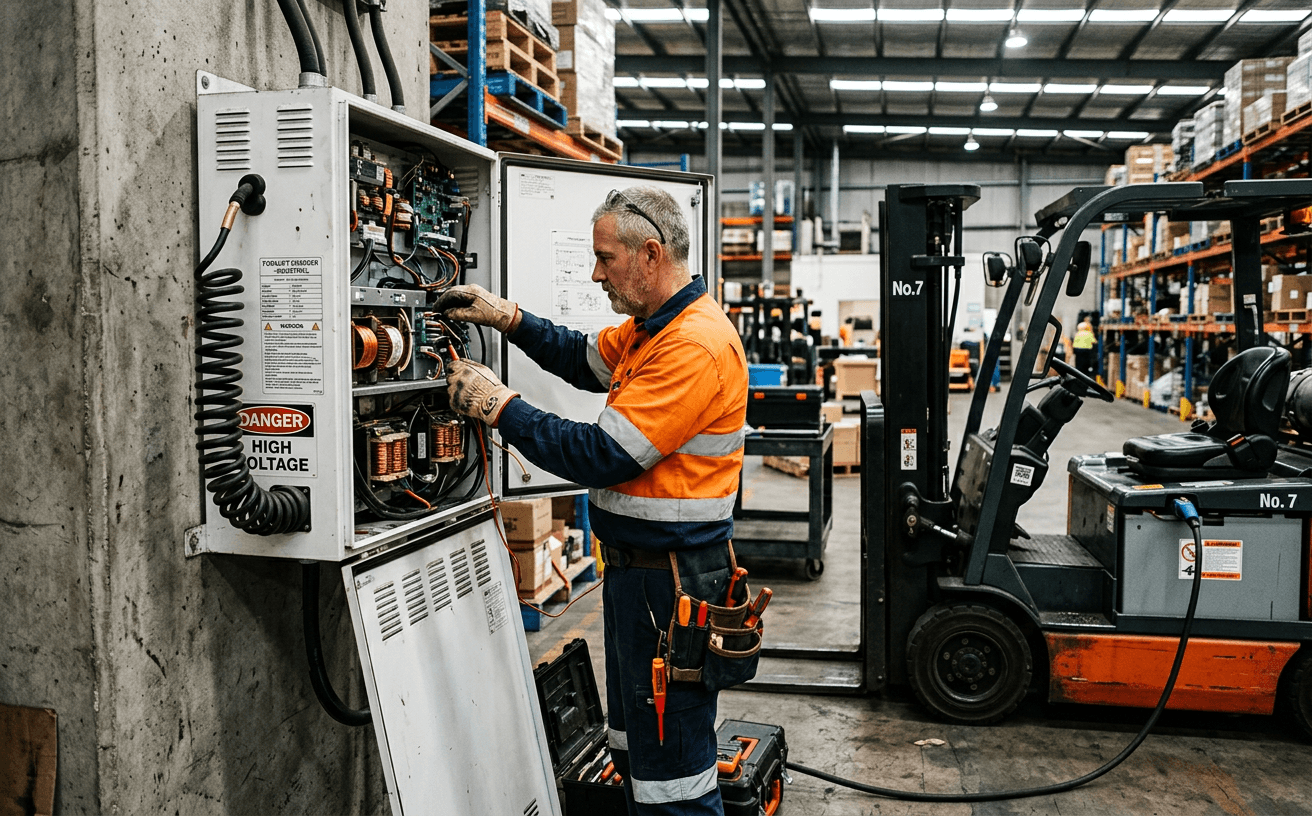
BYD forklift chargers – what is this device?
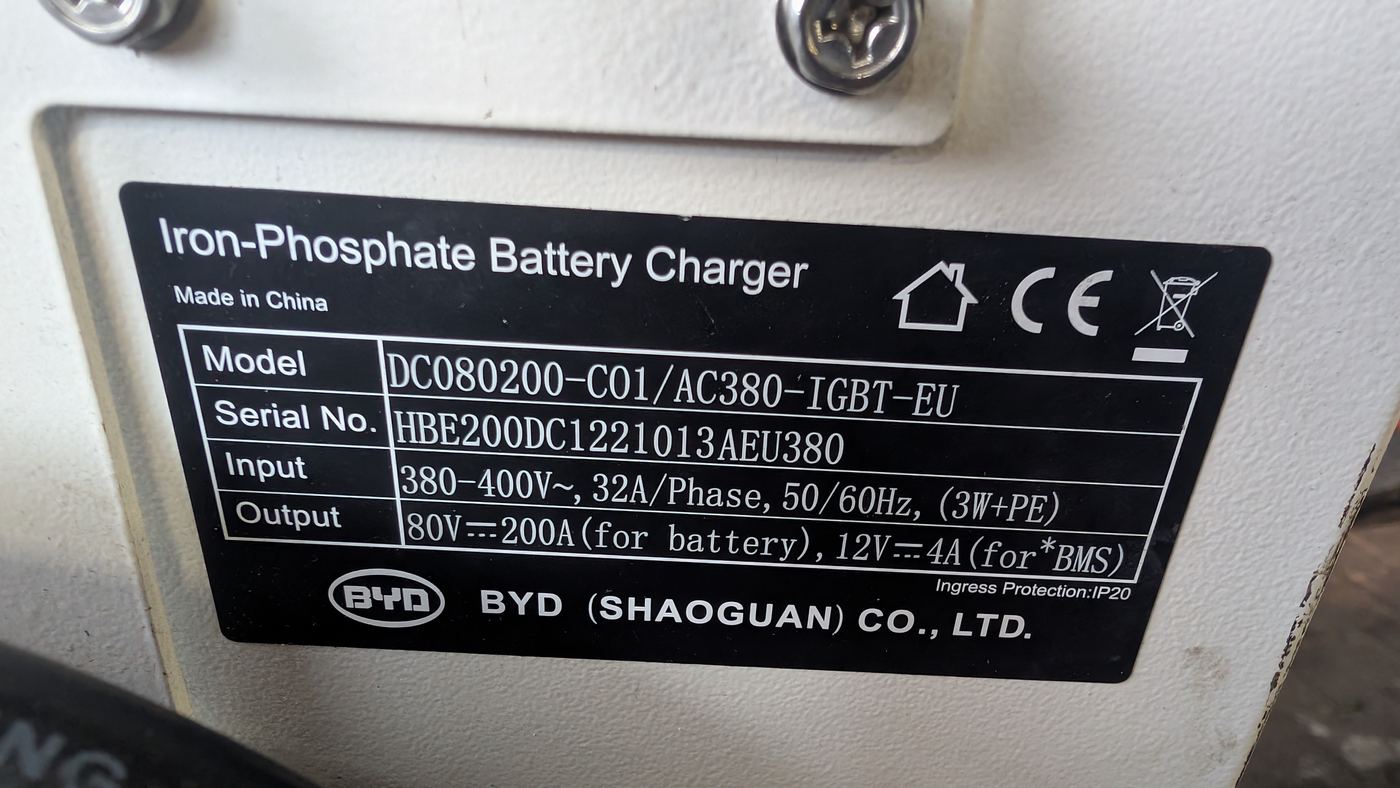
The BYD Iron-Phosphate Battery Charger is a stationary three-phase charger (rectifier) designed for lithium iron phosphate (LiFePO4) batteries used in electric forklifts and other warehouse machines. The unit that came to our workshop has the model DC080200-C01/AC380-IGBT-EU on its rating plate – the European version with an IGBT power stage.
The charger draws power from a 380–400 V mains supply (3 phases + PE, 32 A per phase, 50/60 Hz) and delivers 80 V DC at up to 200 A to the battery, which is about 16 kW. An additional 12 V / 4 A output powers the battery management system (BMS), which communicates with the charger and decides whether charging may begin. The enclosure is rated IP20, so the device is not meant to work in rain or in heavy dust.
| Parameter | Value | Notes |
|---|---|---|
| Model | DC080200-C01/AC380-IGBT-EU | European version, IGBT power stage |
| Input | 380–400 V AC, 32 A/phase, 50/60 Hz | 3 phases + protective earth PE |
| Main output | 80 V DC / 200 A | For the traction battery |
| Auxiliary output | 12 V DC / 4 A | Powers the BMS |
| Ingress protection | IP20 | Dry rooms only, no dust or water |
| Manufacturer | BYD (Shaoguan) Co., Ltd. | CE marking on the plate |
Control panel – what the display and buttons tell you
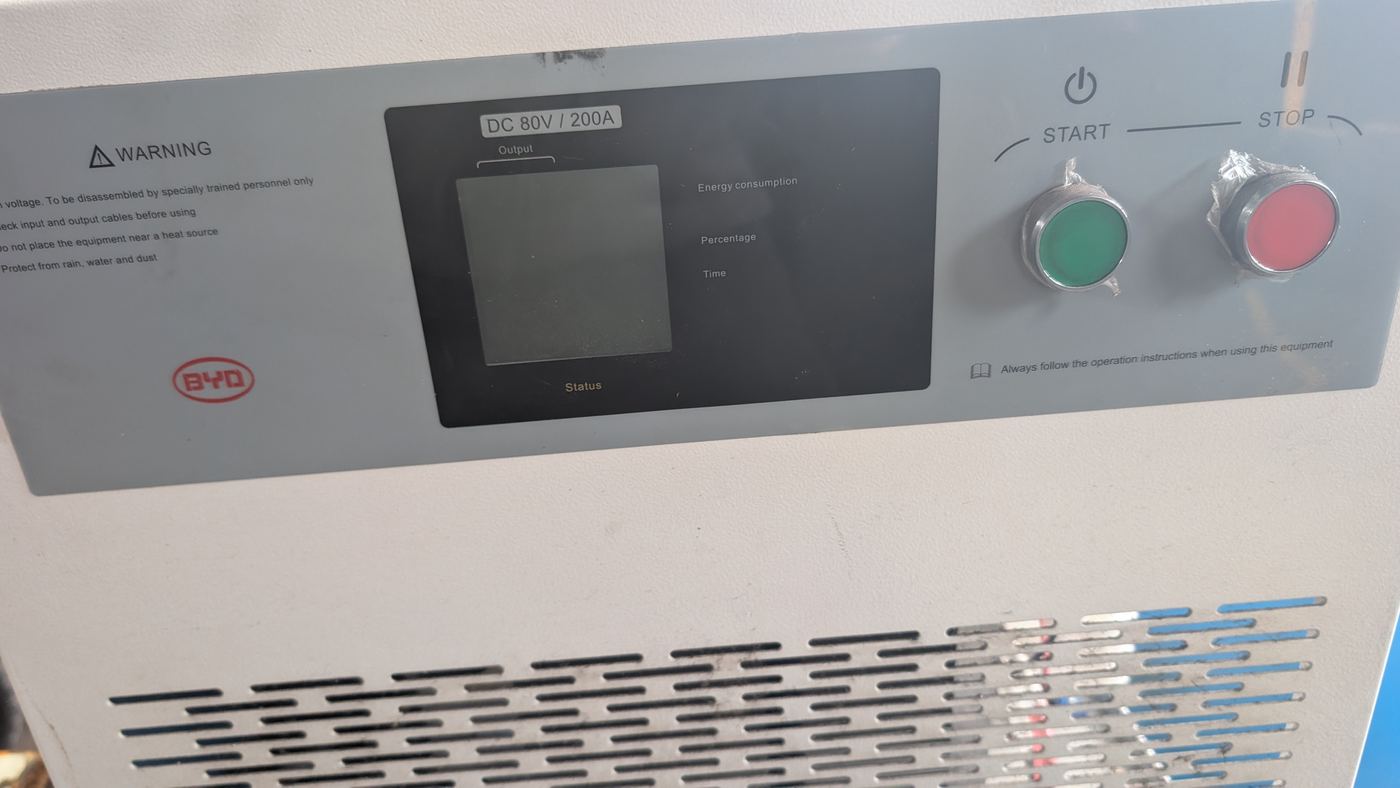
The front of the charger has a display with the fields Output, Energy consumption, Percentage, Time and Status. Operation comes down to two buttons: green START and red STOP. A warning label reminds that only trained personnel may open the device and that input and output cables must be checked before use.
Look at the lower part of the enclosure. The ventilation slots in the photo are dirty, yet a 16 kW charger needs a constant airflow. Dusty cooling channels are one of the most common reasons for power electronics overheating and charging performance dropping.
Most common failure symptoms of BYD chargers
The table below lists typical symptoms and possible causes. These are check points used in the diagnostics of industrial chargers of this type, not a list of manufacturer error codes – the exact cause is determined only after measurements.
| Symptom | Possible cause | Who checks |
|---|---|---|
| Charger does not switch on, display dark | Missing phase, tripped protection, faulty auxiliary power supply | Electrician / service |
| Charging does not start after pressing START | No BMS signal, no 12 V supply for the BMS, faulty output relay | Service |
| Charging stops after a few minutes | Overheating from dusty fans and heatsink, temperature sensor failure | User (visual check) / service |
| Burning smell, discoloured DC cable lugs | Loose or corroded connection in the high-current path | Service |
| Charging current too low | Damaged IGBT module, rectifier diodes or DC-link capacitors | Service |
| Overcurrent protection trips in the switchboard | Short circuit in the power stage, damaged input bridge | Electrician / service |
What the user can check before calling service
The following steps are safe and do not require opening the enclosure:
- Check the circuit breaker and fuses in the switchboard and make sure all three phases of 380–400 V are present.
- Inspect the plug and supply cable as well as the output cables to the battery for cracks, discolouration and burning smell.
- Make sure the charging connector is fully inserted and that the battery reports readiness (the BMS is powered).
- Check that the ventilation slots are not blocked and the charger is not near a heat source.
- Take a photo of the display and rating plate and note when and under what circumstances the problem appeared.
Do not open the charger enclosure. Inside there is 380–400 V mains voltage and DC-link capacitors that stay charged after disconnection. Only trained personnel may open the device.
Service diagnostics step by step
We start with measurements, not with replacing parts blindly. This limits costs and the risk of the fault returning. The standard diagnostic process looks as follows:
- Interview with the user: when the problem appeared, which battery is being charged and whether the charger was moved or overloaded.
- External and internal inspection after discharging the capacitors: signs of overheating, dirt, condition of fans, screw connections and insulation.
- Check of the supply path: fuses, input bridge, PE continuity, phase balance.
- Measurements of the high-current DC path: contact resistance, condition of lugs and busbars at the DC+ and DC− terminals.
- Check of the IGBT power stage, diodes, DC-link capacitors, power resistors and the current sensor.
- Inspection of the control board, the 12 V supply for the BMS, the display and the START/STOP buttons.
- Load test after repair, measurement of output current, voltage and temperatures.
Workshop example: overheated terminals and DC cable lug
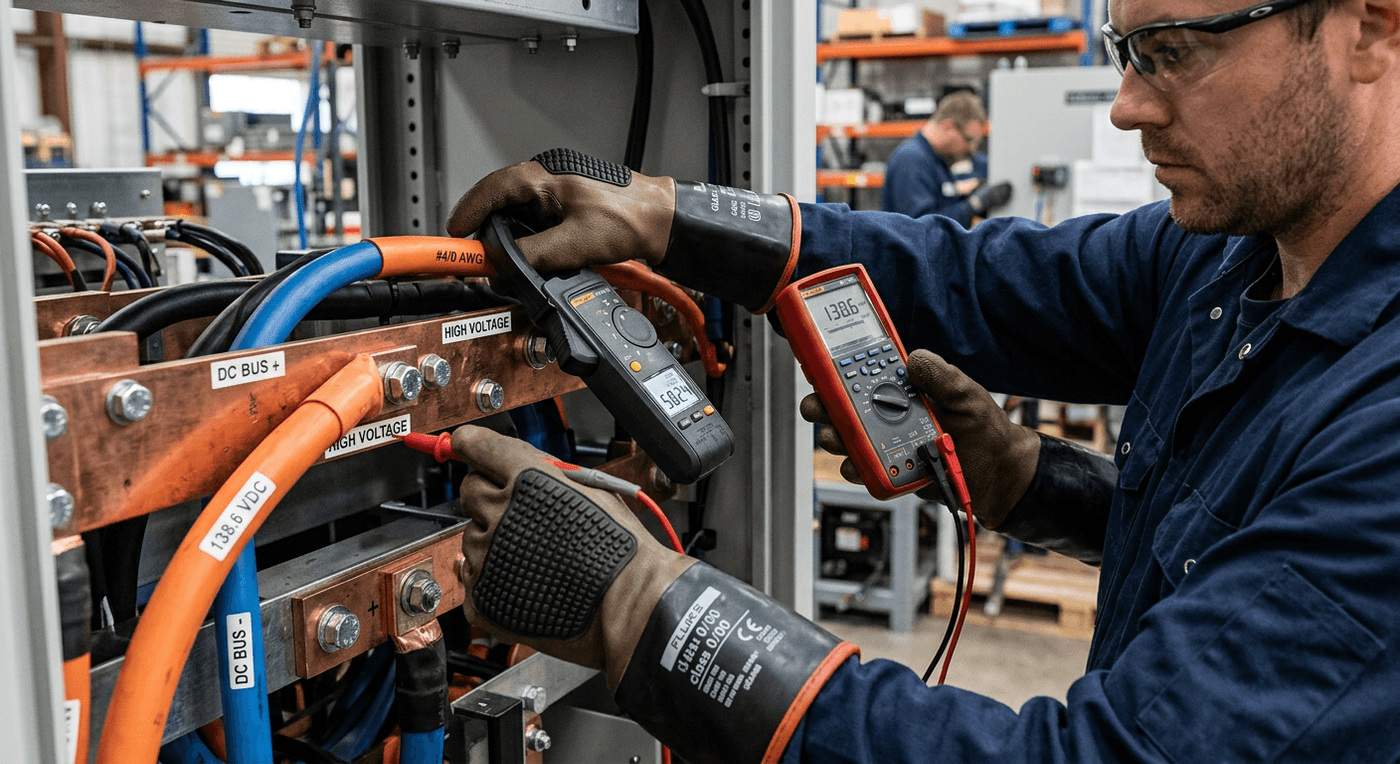
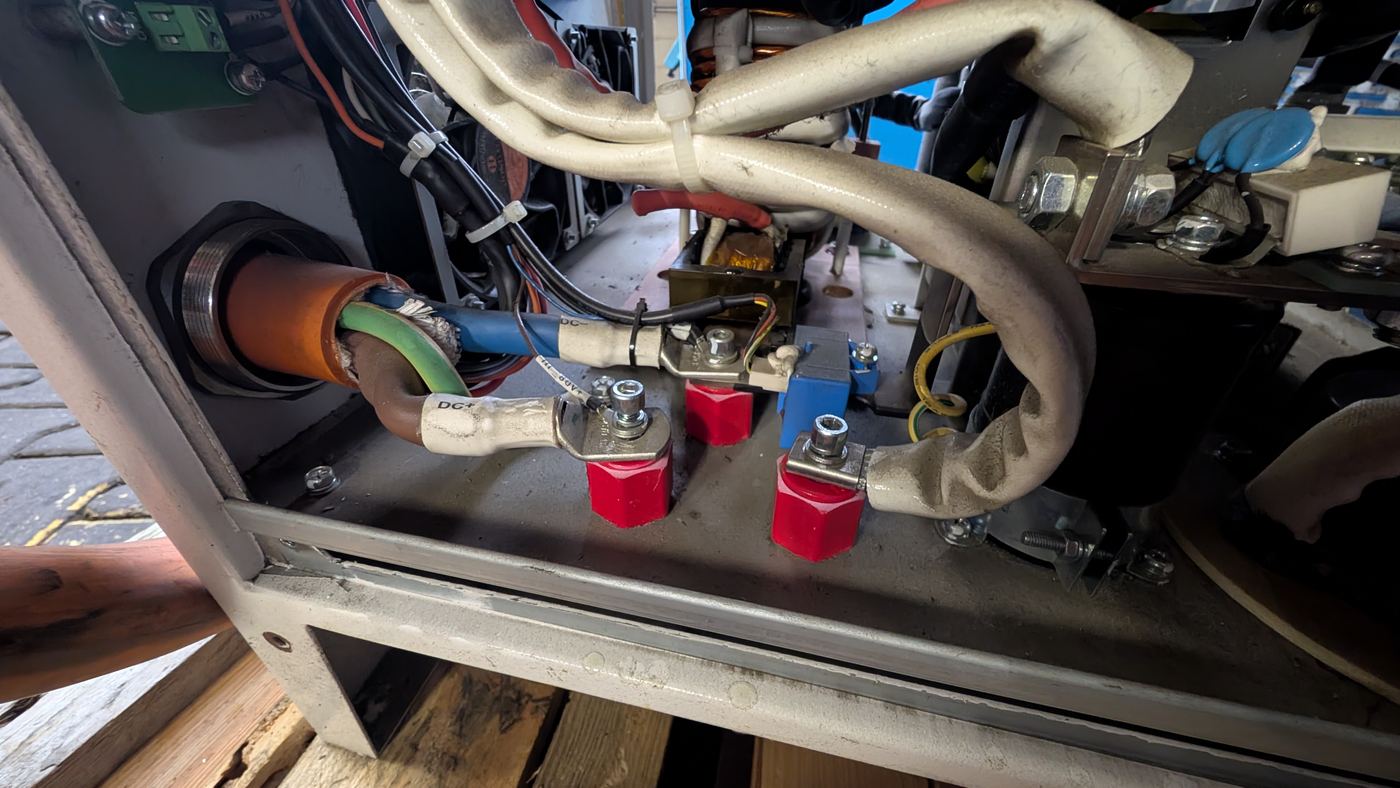
In an 80 V / 200 A charger, hundreds of amperes flow through the DC path. Even a small increase in connection resistance produces heat proportional to the square of the current, so a loose screw or a contaminated contact surface can overheat a cable lug within a few months.
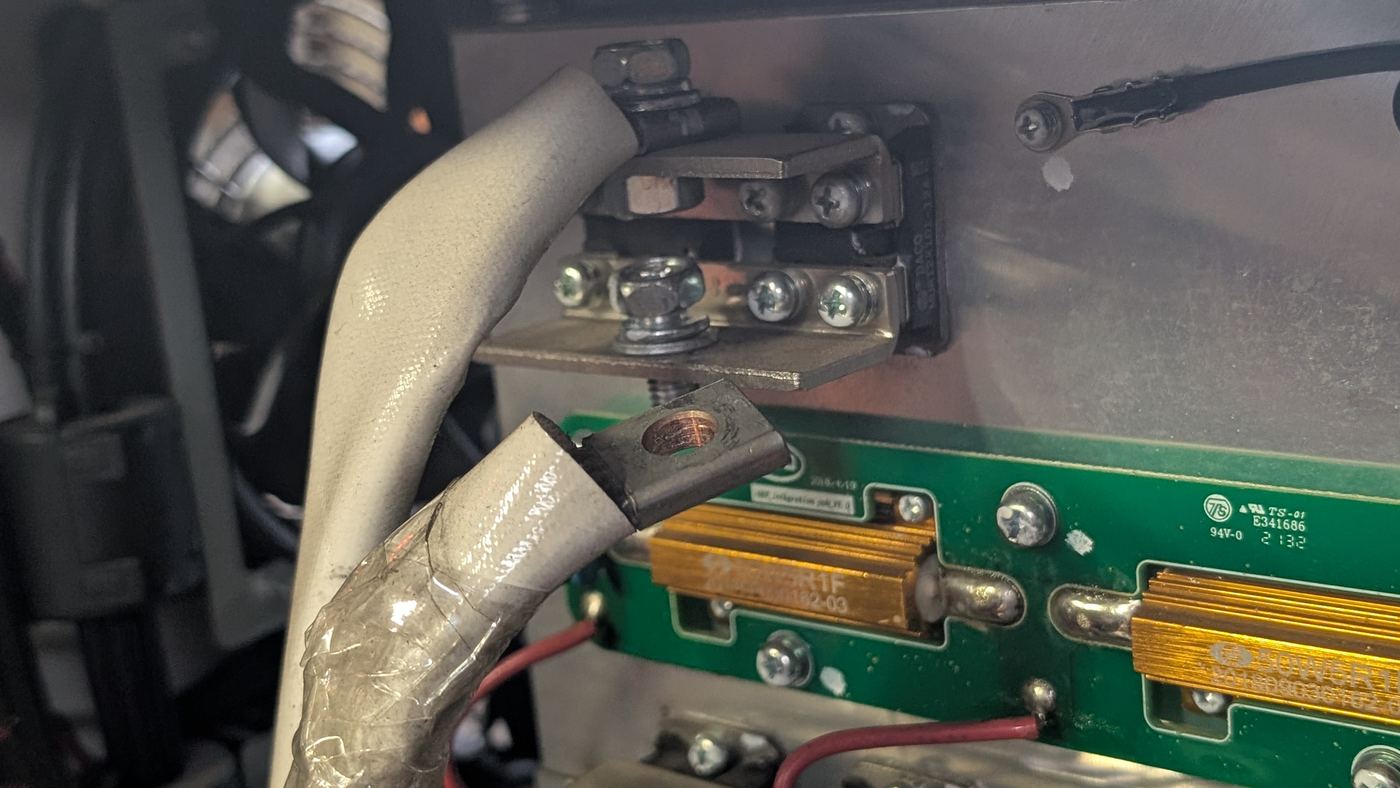
The first photo shows the inside of the charger with the DC+ (brown) and DC− (blue) cables bolted to red insulated output posts. You can also see the cable gland, the power cable sleeving and a blue element near the DC− path that appears to be a current sensor. The second photo shows a disconnected busbar lug with dark discolouration around the mounting hole and 50 W power resistors on the green board beside it. Such marks indicate that the connection ran at elevated temperature and needs assessment, sometimes lug replacement, cleaning of the contact surface and tightening to the correct torque.
Discoloured or burnt-smelling DC cable lugs mean a risk of further overheating and, in extreme cases, fire. Take the charger out of use until it has been inspected by service.
Scope of BYD charger and rectifier repair
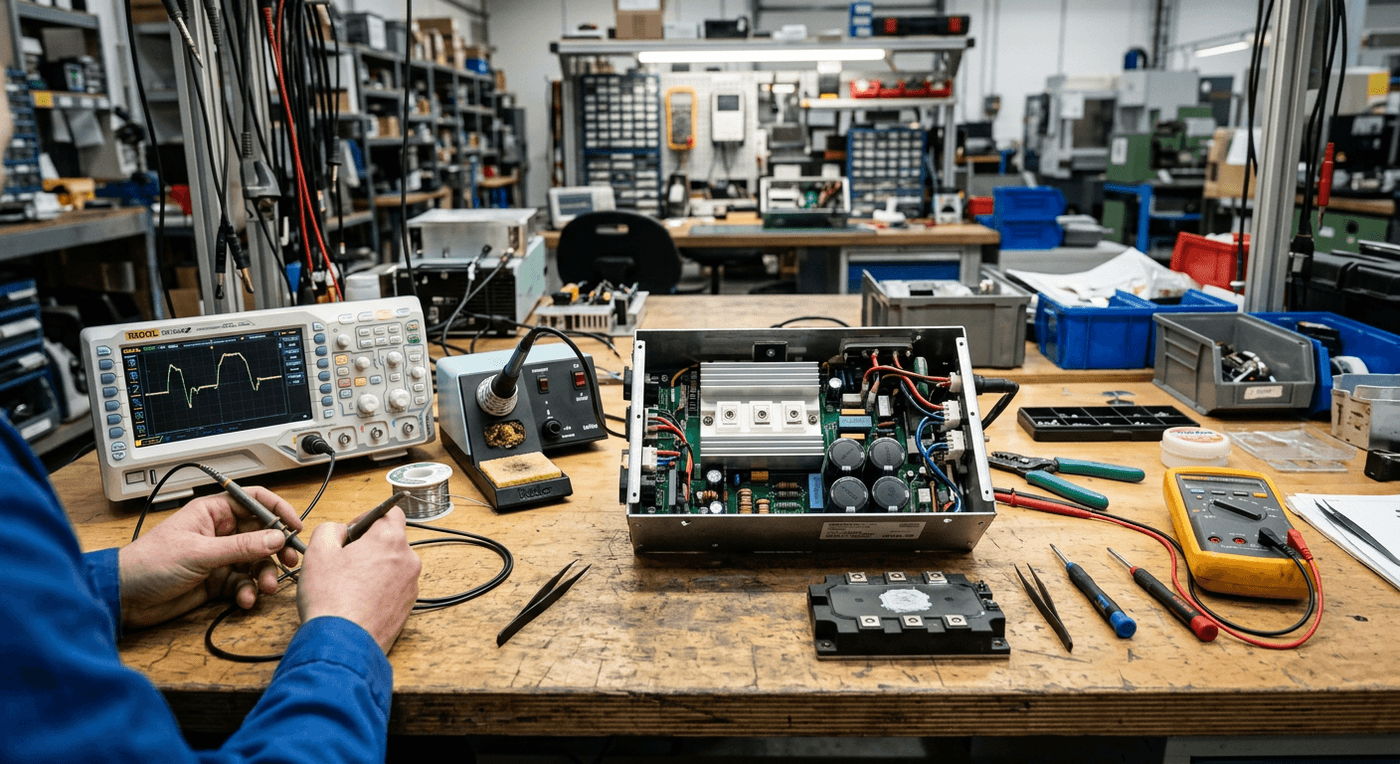
The scope of work follows from the diagnostics. In many cases the repair means fixing the fault in the power path or control electronics, without buying a whole new charger. Quotes are always individual, and after the repair we hand over a report with the measurement results.
| Action | When we use it | Result |
|---|---|---|
| Replacing and cleaning DC lugs and connections | Signs of overheating, increased contact resistance | Stable current flow, no heating |
| Cleaning cooling channels, replacing fans | Overheating, charging interruptions | Full charging power over a long cycle |
| Replacing IGBT modules, diodes and capacitors | Low current, short circuit in the power stage | Rated power of 80 V / 200 A restored |
| Repairing the control board and the 12 V BMS supply | No start, no communication with the BMS | Correct cooperation with the LiFePO4 battery |
| Replacing the output relay/contactor and fuses | No voltage at the output | Full charging voltage at the terminals |
| Replacing the display and START/STOP buttons | No readings, non-working controls | Readable panel and reliable operation |
Safety and prevention
High-power chargers need regular maintenance. We recommend an inspection at least once a year, more often in dusty halls: checking the tightness of DC and AC connections, cleaning the cooling channels, assessing cables and plugs and measuring output parameters. This lets us catch symptoms such as signs of heating before they turn into a failure that stops the forklift fleet.
Also remember the operating conditions that match the IP20 rating: the charger should stand in a dry, ventilated place away from heat sources, water and dust. The supply installation and protection should be checked by a qualified electrician in line with applicable regulations.
Forklift charger service across Poland and Europe
Our base is Knurów in Silesia, from where we serve plants in Gliwice, Rybnik, Zabrze, Katowice and the surrounding area. For companies in Warsaw, Krakow, Wroclaw, Poznan, Gdansk, Lodz and other large cities we offer remote consultation based on photos and a description of the fault, module repair by post and on-site visits by prior arrangement. We work in the same way with customers from Germany, the Czech Republic, Slovakia, Austria, Hungary, the Baltic states and the Benelux countries.
| Area | Service mode | Contact hours |
|---|---|---|
| Silesia (Knurow, Gliwice, Rybnik, Zabrze, Katowice) | Technician visit at your plant | Working days, 8:00–16:00 |
| Largest cities in Poland | Remote consultation, module repair by post, visit by arrangement | Working days, 8:00–16:00 |
| Europe (Berlin, Prague, Vienna, Budapest, Amsterdam and others) | Remote consultation and electronics repair by post | Working days, 8:00–16:00 |
Other chargers and rectifiers we repair
Besides BYD chargers we work on, among others:
- traction chargers and rectifiers for forklifts with lead-acid and lithium batteries,
- high-frequency chargers for pallet trucks and platforms,
- industrial rectifiers and high-power DC power supplies,
- forklift inverters and controllers,
- control boards, IGBT modules and auxiliary power supplies.
How to report a charger fault
Call or write on working days between 8:00 and 16:00. Prepare the model and serial number from the rating plate, a photo of the display, a photo of the inside or terminals (if already visible) and a description of the symptoms. On this basis we will make a preliminary assessment and propose the best way of repair – on site or by post.
Frequently asked questions
- Do you repair BYD DC080200-C01 forklift chargers?
- Yes. We repair BYD 80 V / 200 A chargers for LiFePO4 batteries, including the power path with IGBT modules, DC connections, control boards and the 12 V supply for the BMS.
- The charger does not start after pressing START – what can it be?
- Most often a missing supply phase, no BMS signal or supply, a faulty output relay or a control board failure. The exact cause is established by diagnostics with measurements.
- Why are the DC cable lugs burnt?
- At a current of around 200 A even a minimal increase in contact resistance causes strong heating. The cause may be a loose screw, corrosion or a dirty contact surface. The lugs must be replaced or cleaned and the whole path inspected.
- Can I open the charger myself?
- We do not recommend it. Inside there is 380–400 V and capacitors that stay charged after disconnection. Only trained personnel may open the device.
- Do you serve companies outside Silesia in Poland?
- Yes. Across Poland, including Warsaw, Krakow, Wroclaw, Poznan, Gdansk and Lodz, we offer remote consultation, module repair by post and visits by arrangement.
- Do you repair chargers for customers in Europe?
- Yes. For customers in Germany, the Czech Republic, Slovakia, Austria, Hungary, the Baltic states and the Benelux we provide remote consultation and electronic module repair by post.
- How much does a BYD charger repair cost?
- The quote is individual and depends on the diagnostic result. Contact us and we will prepare a quote after diagnosing the device.
- When can I contact you?
- On working days, Monday to Friday between 8:00 and 16:00, at +48 504 511 170.
Forklift charger not charging?
Describe the model and the symptoms and we will help identify the cause and plan the repair.
A-Core MedServis Śląsk, ul. Kołłątaja 2c/LU1, 44-193 Knurów, woj. śląskie
We serve companies across Poland and Europe
Forklift charger repair for plants in cities including: